
10 Best Web Search APIs for AI Agents in 2026
Not sure which web search API fits your agent? Compare Octen, Exa, Tavily, SerpAPI, Firecrawl, and more across latency, freshness, context quality, and cost.
The best web search API depends on the job the agent needs search to do. A news agent may prioritize freshness, a research agent richer context, and a low-latency workflow speed and cost.
The catch is that one strong metric does not always mean better end-to-end performance. A fast or cheaper provider may only return snippets, forcing extra fetches before the agent has usable context. More results do not always mean better results either.
This guide compares those trade-offs across 10 web search APIs and the agent use cases they are best at.
TL;DR
- The best search API depends on what the agent needs back from search, not one headline metric.
- Octen is strongest for fresh, high concurrency retrieval; Exa for semantic discovery; SerpAPI for real search engine results; and Firecrawl when full page content is the main requirement.
- Response shape matters because snippets, excerpts, full pages, and structured records create very different downstream costs.
- Compare cost per usable retrieval, including extra fetches, extraction, searches, and model tokens.
10 Best Search APIs for AI Agents at a Glance
This table is a quick look at what each search API is best suited for before going deeper.
| Provider | What it is | Best for |
|---|---|---|
| Octen | AI-native web search and retrieval infrastructure | Fresh, high-concurrency retrieval where speed and in-call content matter together |
| Exa | Semantic/neural web search | Semantic retrieval where top-result quality and content depth matter |
| Tavily | Search + extraction for agents and RAG | Research agents and RAG systems that need useful web context with less cleanup |
| Brave Search API | Search over Brave's own web index | Broad web search for agents that need an independent index and can handle deeper fetching themselves |
| Parallel | Search API + research runtime | Structured retrieval and research workflows, from low-level search and extraction to higher-level research APIs |
| SerpAPI | SERP data API | Agents that need actual Google, Bing, or other search-engine results and SERP features |
| Firecrawl | Search, extraction, crawling, and scraping | Agents that need to find, fetch, and process full-page content |
| You.com | Search + answer/research stack | General-purpose agents that need flexible web and news retrieval with different levels of context |
| NewsCatcher CatchAll | Async recall-first discovery | Monitoring workflows that need broad event coverage, validation, deduplication, and structured records |
| Model-native search | Search built directly into an LLM provider | Agents where simple integration matters more than fine-grained retrieval control |
The Four Categories of Search APIs for AI Agents
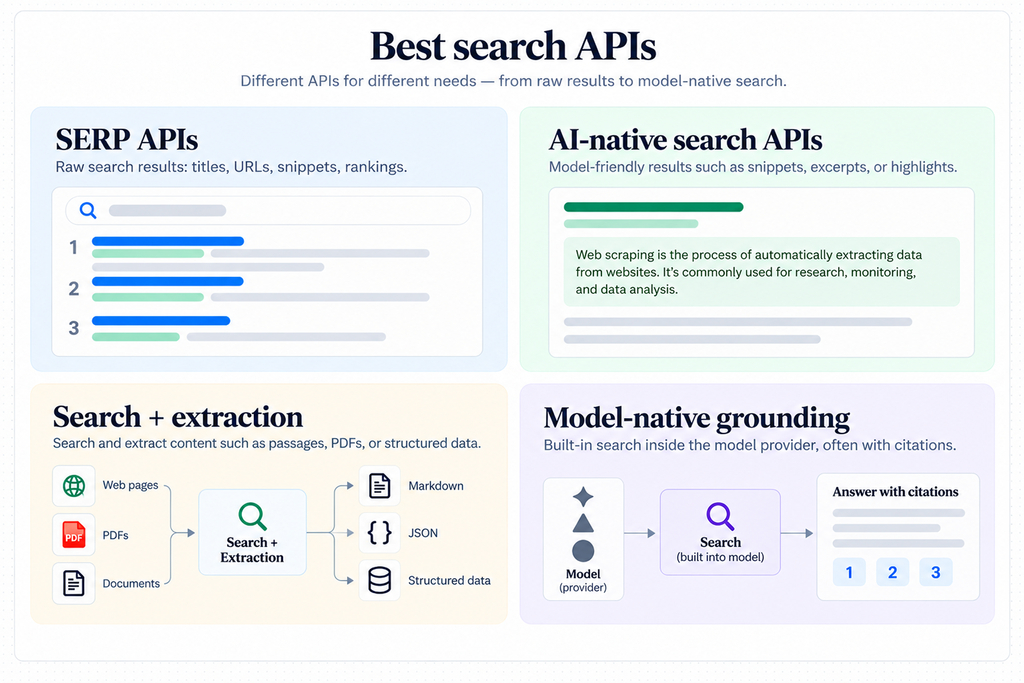
Web search APIs for agents broadly fall into four categories, depending on what they return and how much of the retrieval loop they take on.
1. SERP APIs
SERP APIs return the search results themselves: titles, URLs, snippets, rankings, and features such as People Also Ask or local packs.
They work well for agents that need SERP data directly, like SEO monitoring, rank tracking, competitive research, or lead discovery, and applications that own their own retrieval pipeline for fetching pages and cleaning content.
2. AI-native search APIs
An AI-native search API is built to return information an LLM can use immediately. It does work before returning a result, like semantic search, extracting and cleaning page content, ranking it for relevance, or packaging it as usable context.
The difference between a SERP API and an AI-native web search API is what they return.
A SERP API might return a title, URL, ranking, and a short snippet like "PostgreSQL 18 introduces asynchronous I/O." An AI-native search API returns the specific passage explaining how asynchronous I/O works, what changed, and why it matters, giving the agent more context to reason over without fetching the page first.
3. Search + extraction
This combines web search with page retrieval. Ask "what did Company X raise in its latest round, and who led it?" and an AI-native API returns the most relevant passages, ranked and packaged.
A search + extraction API goes further into the source: it can find the article, fetch it, and extract fields such as amount, investors, date, and company.
The categories can overlap, but the emphasis is different: AI-native search focuses on useful context for the model, while search + extraction focuses on retrieving and pulling information from the source itself.
4. Model-native grounding
This keeps web search inside the model provider. OpenAI, Anthropic, and Google each expose a web search or grounding tool inside their model call, but the available controls and response metadata differ by provider.
It is the simplest path to web-grounded responses, but offers less visibility into ranking, extraction, and evaluation than a dedicated web search API. Most external search tools on this list can still be connected to these models when greater control is required.
How These Search APIs Were Evaluated
Vendor pages often describe their APIs as the fastest or most accurate, but rarely show how they behave inside an agent loop.
This guide is based on hands-on testing in provider UIs and programmatic calls designed to reflect how an agent would use each API. One thing became clear: no single metric is enough. Latency, recall, freshness, and price all matter, but the agent experiences the entire retrieval pipeline.
Higher recall can mean more noise, filtering, deduplication, and token use. Low latency can still lead to extra fetches when a response only returns thin snippets. Each provider was therefore evaluated by the work required to turn a query into usable information for the intended use case.
- Retrieval quality: Are the results actually relevant and useful? A high result count means little if the agent still has to sift through weak sources.
- End-to-end latency: How long does it take the agent to get usable information, not just how fast the API responds?
- Context quality: Does the API return enough useful context, such as excerpts, full-page content, highlights, or structured fields?
- Coverage and source diversity: Does it return enough useful sources without clustering around the same domains or adding too much noise?
- Freshness: Are the results current, with enough metadata to judge recency?
- Control: Does the API support filtering by domain, date, geography, language, search depth, or extraction mode?
- Reliability: How well does it hold up across repeated calls, rate limits, timeouts, inconsistent result counts, and concurrent workloads?
- Cost per usable retrieval: What does it cost to get enough usable information for the agent to continue, including extra fetches, extraction, follow-up calls, and model tokens?
10 Best Search APIs for AI Agents
Here's how the leading options compare in practice, including where each one shines and where it falls short.
1. Octen: Best search API for real time, high concurrency workloads
Octen is an AI-native search platform that combines ranked web search, parallel query expansion, full-page extraction, embeddings, and answer workflows in one stack. An agent can get both search results and the content it needs to reason over without stitching together separate search, scraping, embedding, and extraction providers.
Best use case
Octen fits agents where speed, freshness, and in-call extraction need to work together. That includes news monitoring, competitive intelligence, research agents that fan one question into several subqueries, and high-volume retrieval workloads. In this evaluation, Octen performed well across end-to-end latency, context quality, freshness, and concurrency rather than on just one metric.
Key features
- Web Search: Ranked results with snippets, highlights, and summaries, with the full text of the top 10 results included for free on every search.
- Broad Search: Breaks one query into subqueries and runs them in parallel, useful for research across several angles.
- Extraction: Extract returns clean Markdown, highlights, and page classification, with up to 20 URLs in a single request.
- Multimodal search: Separate image and video search APIs extend retrieval beyond text.
- Embeddings: Text and multimodal embedding models are available in the same platform.
- Model Gateway: One API provides access to frontier LLM and multimodal models with Octen Search built in.
- High concurrency and low latency: Octen reports 62 ms P50 latency and support for 1M+ QPS.
- Freshness: New content can appear in the index usually within five minutes of publication.
- Agent integrations: REST API, Python SDK, CLI, MCP server, and Agent Skills give agents several ways to use the search stack.
Where it wins
- Low latency and high concurrency make it a strong fit for retrieval-heavy agent workloads.
- Full-content costs are predictable: the first 10 results are free, then additional results cost $0.50 per 1,000.
- Broad Search can reduce multi-step research loops by running related searches in parallel.
- Search, extraction, embeddings, and multimodal retrieval in one platform reduce provider sprawl.
Where it loses
- Broad Search can increase cost because each generated subquery is billed separately.
- Signup starts at 10 QPS; adding credits unlocks the 20 QPS Base tier.
- Some multimodal and wider platform capabilities are still in early access.
2. Exa: Best search API for semantic retrieval and top-result quality
Exa is a neural web search engine built around embedding based retrieval rather than keyword matching. Instead of returning a broad list of links for the agent to sift through, it aims to surface the pages most relevant to the query, with optional content and highlights in the same call.
Best use case
Exa fits agents where top result quality, semantic understanding, and content depth matter together. That includes QA agents where the first few sources matter most, research agents doing multi hop reasoning, and vertical assistants searching specific document types. In this evaluation, Exa stood out for retrieval quality and context quality together.
Key features
- Neural search: Finds pages based on the meaning of the query, not just matching the same keywords. This makes it useful for descriptive or intent-heavy searches.
- Content in the response: Full page text, highlights, and summaries can come back with the search result.
- Similarity search: Given a URL, Exa can return semantically similar pages for discovery and find more like this workflows.
- Filters: Domain, date, and content type filters help constrain retrieval.
- Livecrawl: Crawls pages on demand when they are missing from the index.
Where it wins
- Strong ranking quality for descriptive and long form queries.
- Content and highlights in the same call reduce downstream fetching.
- Similarity search supports useful discovery workflows.
- Livecrawl helps close freshness gaps on niche pages.
- Strong fit when the agent needs fewer, better results with enough context to reason over.
Where it loses
- Semantic ranking is less useful for exact-match queries, such as a specific code, product SKU, or string, where keyword precision matters more.
- Broad SERP style coverage and fast moving news are not Exa's strongest fit, especially when Livecrawl is needed to close freshness gaps.
- Livecrawl can add latency when triggered.
- Coverage can be thinner than generalist SERP providers on obscure queries.
3. Tavily: Best search API for research agents needing curated, LLM ready results
Tavily is a search and extraction API for AI agents and RAG workflows. It can return ranked search results, relevant content from those pages, and optionally full-page content or a generated answer in one call.
Best use case
Tavily fits research agents and RAG systems that need useful web context with less cleanup. Its strength is control over retrieval: developers can choose faster or deeper search, filter sources by time or topic, and return snippets, full-page content, or a generated answer.
Key features
- Search API: Returns relevance ranked results with query relevant content rather than only links and generic snippets.
- Search depth: Ultra-fast, fast, basic, and advanced modes provide different trade-offs between latency and retrieval depth.
- Content in the response: Full page content can be returned with search results, reducing separate page fetching.
- Answer generation: An optional generated answer can come back alongside the sources.
- Search controls: Domain, date, country, topic, result count, and other filters help shape retrieval.
- Extract API: Extracts clean content from specific URLs when the agent needs to go deeper after search.
Where it wins
- Strong fit when the agent needs useful context rather than raw SERP output.
- Advanced search can return richer context per source.
- Raw content in the search response can reduce downstream fetching.
- Optional answers can shorten simple search and synthesis loops.
- Strong controls for research agents working with specific sources, dates, locations, or topics.
- Search and extraction in one platform reduce retrieval glue code.
Where it loses
- Advanced search uses more credits than basic, fast, or ultra-fast search.
- Deeper retrieval and raw content can add latency, so richer context comes with an end-to-end cost.
- It is less suited to workloads that want raw SERP data or broad recall to rerank independently.
- Search result limits can be restrictive for recall-heavy discovery workflows.
- Agents that already have their own fetching, extraction, and reranking pipeline may find some of Tavily's built-in shaping redundant.
4. Brave: Best search API for independent index and straightforward SERP results
Brave Search API runs on Brave's own web index rather than reselling Google or Bing results. That independence is the main differentiator, giving teams more control over coverage, pricing, and reliance on third party search providers.
Best use case
Brave fits agents that want broad web search from an independent index and prefer to handle ranking, fetching, and extraction themselves. It is a strong fit for privacy conscious applications, search products that want less dependence on Google or Bing, and workflows where simple titles, URLs, and snippets are enough for the first retrieval step.
Key features
- Independent index: Brave crawls and ranks its own web index rather than reselling another provider's results.
- SERP style output: Returns titles, URLs, and snippets in a familiar search result format.
- Filters: Country, language, safesearch, and date controls help constrain retrieval.
- News and video search: Dedicated endpoints for news and video results.
- Goggles: Custom ranking rules that let developers reshape result ordering for specific use cases.
Where it wins
- Independent index reduces reliance on Google or Bing based providers.
- Clean SERP output is easy to plug into existing retrieval pipelines.
- Strong fit when the agent already handles fetching, reranking, and extraction itself.
- Good control over geography, language, date, and result type.
- Goggles provide an unusual level of ranking customization.
Where it loses
- Short snippets can force extra page fetches before the agent has enough context to continue.
- It is less suited to agents that need full-page content, synthesis, or extraction in the same call.
- Coverage can be thinner on niche or long-tail queries.
- Workflows that need deeper context may require a separate scraper or extraction layer, increasing end-to-end latency and cost.
5. Parallel: Best search API for agents that need structured, extractable results
Parallel is a retrieval API built to return results in shapes agents can act on directly, with structured fields, extracted content, and clean formatting oriented toward downstream automation rather than human reading.
Best use case
Parallel fits agents that need structured web data for downstream automation, such as pulling pricing, product, or company information into other tools. It is especially useful when the search result needs to become an action or structured input, rather than just context for a model to read.
Key features
- Structured search results: Results come back with metadata and extractable fields beyond the standard title, URL, and snippet.
- Content extraction: Full page content available in the search response, similar to a search plus fetch combined.
- Token-relevance ranking: Ranks and compresses results by reasoning utility against a natural-language objective, rather than by human engagement signals.
- Filters: Standard domain, date, and language controls.
- Predictable output shape: Consistent response format makes downstream parsing cheaper.
Where it wins
- Structured output reduces the parsing and cleanup work agents typically do after search.
- In response content extraction cuts out a separate fetch step.
- Fast Search tiers make Parallel a strong option for latency-sensitive agent workflows, with Turbo positioned around ~200 ms.
- Ranking is driven by a natural-language objective alongside the keyword query, which holds up on multi-step questions where other providers return loosely related pages.
- Predictable response shape helps with reliability in production agents.
Where it loses
- Less useful for exploratory or discovery queries where raw breadth matters.
- Documentation and ecosystem are lighter than more established providers.
- The combination it serves is structured output plus in-response extraction. Agents that just need a ranked list of links are paying for shaping they will not use.
6. SerpAPI: Best search API for pulling real Google, Bing, and search engine results
SerpAPI is a scraping-as-a-service layer over major search engines. Instead of maintaining its own index, it fetches live SERPs from Google, Bing, Yahoo, and DuckDuckGo and returns them as structured data.
Best use case
SerpAPI fits agents that need actual search-engine result pages, not just relevant web pages. It is especially useful for SEO, rank tracking, competitive analysis, and workflows that depend on Google-specific SERP features like featured snippets, knowledge panels, related searches, and local packs.
Key features
- Multi engine search: Supports Google, Bing, Yahoo, DuckDuckGo, Baidu, Yandex, YouTube, shopping engines, maps, news, and many other search surfaces.
- Full SERP structure: Returns organic results alongside rich SERP features such as ratings, related questions, carousels, sitelinks, and other search specific metadata.
- Location and language controls: Lets agents reproduce searches from specific locations and locales.
- Structured output: Returns parsed JSON, with Markdown output also available for LLM workflows.
- Caching: Identical searches can use cached results for up to one hour. Cached searches do not count toward the monthly quota.
- Agent integrations: REST API, official SDKs across several languages, CLI support, and an MCP server for tools such as Claude Code, Codex, Cursor, and VS Code.
Where it wins
- The only realistic way to get actual Google search or Bing results in a structured, agent friendly form.
- SERP feature coverage is far richer than any independent index provider.
- Multi engine support is useful for competitive or comparative workflows.
- Structured JSON output avoids the parsing tax of DIY scraping.
Where it loses
- Latency sits on the slower end because every call is a live SERP fetch.
- Snippets are short by SERP convention, so downstream fetching is usually needed for reasoning.
- Returned volume per call can undershoot the request depending on SERP shape.
- Pricing scales with volume more steeply than index based providers.
- Legally and operationally sits on top of scraping, which some workloads want to avoid.
- The combination it serves is real SERP output plus multi-engine reach. When an agent does not specifically need Google-flavored results with SERP features, an index-based provider may offer lower latency and cost.
7. Firecrawl: Best search API for agents that need full page content, not snippets
Firecrawl is built around the fetch and extract half of the retrieval loop. It crawls URLs on demand, returns clean Markdown or structured JSON, and offers a search endpoint that pairs discovery with full page content in one call.
Best use case
Firecrawl fits agents that need to read and process full pages. It is especially useful for RAG pipelines, documentation or article analysis, and workflows where fetching and cleaning page content would otherwise be the main bottleneck.
Key features
- Search: The front door. Finds fresh sources from the live web and can return their full content in the same call, not just snippets.
- Scrape: Turns any URL into clean Markdown or structured JSON. Handles JavaScript rendered pages, anti bot, and geo sensitive sites.
- Crawl: Recursive crawling of a domain or path for bulk ingestion.
- Map: Discovers site structure fast, returning all URLs on a site without downloading content.
- Interact: Keeps a live browser open so the agent can click, scroll, fill forms, log in, and reach data behind dynamic interactions.
- Parse: Converts PDFs and documents into clean, usable text.
- Monitor: Notifies the agent when pages or sites change.
- Agent: Preview endpoint powered by spark-2 for extraction and research tasks with dynamic pricing.
- Integrations: API, Python and Node SDKs, CLI, MCP server, and drop in Skills for Claude Code, Cursor, Codex, and other AI coding agents.
Where it wins
- Full page content in the search call eliminates the fetch then parse step most agents write themselves.
- Markdown and JSON output are LLM ready, not just text stripped from HTML.
- Handles JS heavy sites, anti bot, and dynamic pages that break basic scrapers.
- Crawl, Map, Interact, Parse, and Monitor cover ingestion workflows other search providers do not touch.
- Broad AI agent integration surface (MCP, CLI, Skills) means the tool slots into modern coding agents cleanly.
Where it loses
- Latency sits on the slow end because every call involves fetching and rendering pages.
- Overkill for workloads that only need snippets or ranked URLs.
- Cost is higher than snippet-only or index-based providers, and features like JSON extraction and Stealth Mode can raise it to around 5 credits per request.
- Search ranking is less refined than dedicated search providers. Firecrawl's edge is content, not ranking.
- Credits do not roll over on standard plans, so bursty workloads pay for unused capacity.
- The combination it serves is search plus real page content plus clean extraction. Using it for lightweight lookups means paying fetch tier latency and cost for content the agent was not going to read anyway.
8. You.com: Best search API for multi modal search with fast, sectioned results
You.com API provides web search, content extraction, answers, and deeper research through the same platform. Its Search API returns structured web and news results with LLM ready snippets, with optional highlights or full page content when the agent needs more context.
Best use case
You.com fits general purpose agents that need fresh web and news retrieval without building a large retrieval stack themselves. Its strength is the balance between speed, context quality, and control. An agent can start with lightweight snippets, request highlights for more focused context, or pull full page content when deeper reasoning is needed.
Key features
- Web Search: Returns structured web and news results in the same request, with up to 100 results per call.
- Flexible context: Choose snippets, query relevant highlights, or full page content depending on how much context the agent needs.
- Contents API: Fetches clean Markdown or HTML from specific URLs.
- Answer API: Combines search and synthesis into a citation backed answer.
- Research API: Runs multiple searches, reads sources, and produces a cited response for more complex questions.
- Search controls: Supports country, language, freshness, domain, and other retrieval filters.
- Agent integrations: REST API, Python and TypeScript SDKs, MCP, Agent Skills, CLI, LangChain, Vercel AI SDK, and other agent frameworks.
Where it wins
- Web and news results come back through one search API.
- Lets the agent choose between lightweight snippets, focused highlights, and full page content.
- Search, extraction, answers, and deeper research are available in the same platform.
- Up to 100 results per search gives recall focused agents more room than APIs with smaller result limits.
- Broad agent and framework integration support.
- Strong fit when no single retrieval requirement dominates and the agent needs a flexible general purpose search layer.
Where it loses
- Full page extraction costs extra, so a search that looks inexpensive can cost more when the agent needs content from many results.
- Search results alone still rely on snippets or highlights unless full page extraction is enabled.
- More specialized workloads may be better served elsewhere. Exa is stronger when semantic ranking is the priority, Octen when very high concurrency and retrieval speed dominate, and Parallel when the workflow centers on structured or ongoing web research.
- Using Answer or Research moves more of the retrieval loop into You.com, which gives the application less control than building that reasoning layer separately.
9. NewsCatcher CatchAll: Best search API for recall first event discovery and monitoring
CatchAll is different from the ranked search APIs on this list. Instead of returning the top pages for a query, it finds matching real-world events across a time window and returns validated, structured records with supporting sources.
Most searches run asynchronously, while Lite mode can return results faster.
Best use case
CatchAll fits agents that need broad event coverage rather than a few top-ranked results. It is especially useful for funding, product launch, regulatory, and supply-chain monitoring, where the goal is to find many qualifying events without making the agent filter and deduplicate pages itself.
The tradeoff is speed, so it is better suited to monitoring and background workflows than interactive agent loops.
Key features
- Recall first discovery: Searches for matching events across a corpus rather than ranking only the top pages.
- Structured records: Base mode can return extracted fields such as company, event type, amount, date, or other query specific attributes.
- Validation and deduplication: Results are checked against the query and returned as distinct events rather than duplicate articles about the same event.
- Citations: Records include supporting source links so the agent can verify the result.
- Monitors: Turn a search into a recurring feed that returns only new, deduplicated events.
- Watchlists: Scope searches and monitors to specific companies or entities.
- Agent integrations: REST API, Python, TypeScript and Java clients, MCP, LangChain, Make, Apify, and webhook delivery.
Where it wins
- Strong fit when the goal is to find many qualifying events rather than only the top ranked pages.
- Structured extraction reduces downstream parsing and model work.
- Validation and deduplication can reduce noise before results reach the agent.
- Pricing is tied to validated records in Base mode rather than every page processed.
- Monitors turn one off discovery into continuous event tracking.
- Citation backed records are useful for workflows where results need to be verified.
Where it loses
- Base searches are asynchronous and can take around 10-15 minutes, making them unsuitable for low latency chat or interactive retrieval.
- It is specialized around real world events and records, not generic factual web search.
- Query quality matters because the event definition, time window, validators, and enrichment fields shape what gets returned.
- Lite mode is faster but gives up the richer extraction available in Base mode.
- If the agent only needs the best few pages for a question, a conventional search API is a simpler fit.
10. Model native search (OpenAI, Anthropic, Gemini): Best when search needs to happen inside the model call
Model-native search is web retrieval built directly into frontier model platforms. OpenAI, Anthropic, and Gemini can let the model decide when to search, retrieve information, and reason over the results without a separate search API.
Best use case
Model-native search fits agents where simplicity matters more than fine-grained retrieval control. It is especially useful for prototypes, internal tools, and general assistants that need web search as one capability among many without adding another retrieval provider.
Key features
- Model triggered retrieval: The model decides when a query needs search, runs it, and incorporates results. No separate agent scaffolding required.
- Single call reasoning: Search, synthesis, and citation happen inside one API call.
- Provider managed sources: The provider controls the index, freshness, and ranking, so retrieval quality is managed within the model platform rather than separately.
- Citations: Each of the three returns source URLs alongside grounded answers.
- Native to the model API: No new SDK, auth, or billing surface to add.
Where it wins
- Simplest possible integration path for adding search to a model application.
- No orchestration between a search provider and a model provider.
- Cheaper to prototype with than assembling a full search plus model stack.
- Retrieval quality on general queries has improved substantially and is often good enough for consumer grade use cases.
Where it loses
- Less control over ranking, sources, and freshness.
- Harder to predict and optimize retrieval cost.
- Weaker fit for strict source curation, auditing, or vertical tuning.
- Retrieval behavior can change with the model or provider.
- Poor fit when search is a core product capability.
Decision Framework for Choosing the Right Web Search API
The best search API depends on what search is doing inside the pipeline. The process starts with the job, then considers what the API returns, applies the workload's operational constraints, and tests the top two or three providers on real queries.
The job should narrow the shortlist before price or latency:
- Semantic discovery → Exa
- RAG with clean context → Tavily, Firecrawl
- Real-time retrieval at volume → Octen
- Google SERPs with features → SerpAPI
- Full-page content → Firecrawl
- Async event or record recall → CatchAll
Once the shortlist is set, the next consideration is response shape. Two APIs can find the same URL but create very different downstream work. A thin snippet may force the agent to fetch the page before it can continue, while an excerpt or full-page content may already contain what it needs.
Next come the workload's operational requirements. Freshness, coverage, latency, concurrency, control, and cost matter differently depending on the agent. The important number is not just how fast or cheap the search request is, but how much work is required to turn that response into usable context.
Finally, the top two or three providers should be tested on real queries from the application. The comparison should measure how often the first response is usable, how many extra searches or fetches follow, and the total latency and cost of getting to an answer.
Example 1: News monitoring agent
Consider an agent that checks competitor news every 10 minutes. The job immediately puts Octen, Brave, and You.com on the shortlist because freshness and frequent retrieval matter more than semantic depth or heavy extraction.
Next comes the response itself. If Brave returns a useful result but the agent still has to fetch the page for enough context, that extra step matters. Octen and You.com may move ahead if they return more usable context in the initial retrieval.
At this point, freshness, concurrency, latency, and cost per useful alert become the deciding factors. The finalists should be tested against real competitor announcements to compare which one consistently catches new information with the least downstream work.
Example 2: RAG assistant
Consider an assistant that answers questions using a set of documents. The job points toward Tavily, Exa, and Firecrawl because the agent needs to find the right source and retrieve enough content to answer from it. SerpAPI and CatchAll are less relevant because raw SERPs and event discovery are not the problem being solved.
Here, snippets are unlikely to be enough. Semantic relevance, useful excerpts, full-page extraction, domain controls, and token cost matter more than extreme freshness or very high concurrency. Exa may perform better for conceptual queries, Tavily when cleaner LLM-ready context matters, and Firecrawl when the agent needs to retrieve and process difficult pages.
The finalists should be tested against real user questions to compare whether the first retrieval contains the information needed to answer, how much additional fetching follows, and the total context cost.
How to Compare Web Search API Pricing
A fair comparison starts with cost per usable retrieval, not price per search.
First, break down each provider's pricing: separate the search request from costs tied to returned results, page fetching, extraction, tokens, research tasks, credits, or reserved QPS. This keeps pricing models comparable even when providers meter different parts of retrieval.
Next, map what happens after the initial search. Does the response already give enough context to continue, or does it need further page retrieval, extraction, or model processing? Count those downstream steps rather than treating the search request as the full cost.
Then test providers against the same workload: same number and type of queries, similar result depth, equivalent content requirements, and the same expected traffic or concurrency. This stops a cheaper, lighter search call from looking equivalent to a fuller retrieval.
Finally, calculate the full path from query to usable information: search, additional retrieval, extraction, reasoning, and any concurrency costs the workload requires.
Conclusion
The pattern across every provider on this list is the same: judging a search API on a single metric misses how the tool actually behaves inside an agent loop. The API should be matched to the job, tested on representative queries against the two or three strongest fits, and measured by cost per usable answer rather than cost per call.
For workloads centered on real-time retrieval under load, freshness-sensitive monitoring, or research agents that fan one question into many, start a free evaluation with Octen.
Frequently Asked Questions
What is the best search API for AI agents?
The best search API depends on what the agent needs search to do.
Start with the job. If an agent monitors competitor launches, freshness matters more than semantic discovery or full-page crawling. Then look at what the API returns. A fast API that only gives snippets may still need another fetch, while a slightly slower one that returns useful context may get the agent to an answer faster overall.
Next, apply the operational requirements. High-volume agents need strong concurrency and low latency; a workflow that runs a few times a day may care more about context quality or cost. Then test the top two or three providers on real queries and compare usable results, extra steps, total latency, and cost.
The best API is the one that performs best across the whole search-to-usable-context loop for the agent.
What is the difference between a SERP API and an AI-native search API?
A SERP API is optimized to return search-engine results: titles, URLs, rankings, snippets, and SERP features.
An AI-native search API is optimized to return context an AI agent can use directly, such as relevant passages, cleaned text, or full-page content.
For example, if an agent asks, "Which companies announced new data centers in Europe this month?" a SERP API may return the relevant ranked results, while an AI-native API may return the passages describing the announcements.
The categories can overlap. SERP APIs may add extraction or LLM-ready output, and AI-native APIs may still return titles, URLs, and snippets. The difference is mainly what they are designed to give the agent first.
Which search API offers the best real-time data for AI agents?
For fresh web retrieval at high volume, Octen is the strongest fit in the comparison because it combines low-latency search, high concurrency, and a freshness-first index.
The answer changes slightly depending on what real-time means for the agent. If the agent needs fresh web information as quickly as possible, Octen is one option to test. If it specifically needs live Google or Bing results, SerpAPI is another fit. If it needs fresh results from an independent web index instead, Brave is worth testing.
Whichever category fits, the finalists should be tested on the kinds of news, content, prices, or events the agent actually needs to catch.